

Houston stands as one of the fastest-growing cities in the country, and practically every new resident arriving from Sugar Land to Humble needs a haircut. For those tired of the traditional 9-to-5 grind, this rapid population expansion makes the local barbering scene a uniquely low-risk career path with built-in demand. Rather than worrying about automation replacing your job, the challenge here is simply finding the right training to capture a piece of this booming market.
Before you can legally claim a chair, you must navigate the requirements set by the Texas Department of Licensing and Regulation, commonly known as the TDLR. Think of the TDLR as the agency that sets the rules of the road; they determine the safety standards and education necessary to ensure every professional meets a specific baseline of competence. While the state paperwork might seem intimidating initially, the guidelines are designed to protect both your future career and your clients.
Progress in this trade is measured in “clock hours,” which is simply the industry term for the actual time you spend in the building learning your craft. These hours serve as your mandatory flight time before you are allowed to fly the plane solo. Accumulating these credits efficiently is the vital first step on the timeline between enrollment and earning your first paycheck as a licensed pro.
Class A Barber vs. Cosmetology: Which Texas License Unlocks Your Goals?
Most people assume anyone with scissors can work in any shop, but the Texas Department of Licensing and Regulation (TDLR) draws a sharp line between stylists and barbers. While a cosmetologist focuses heavily on long hair styling, makeup, and nails, a Class A Barber license is strictly specialized for short hair and facial grooming. If your dream involves fading a high-top or shaping a beard in a shop near the Galleria, picking the right educational path now prevents you from needing to go back to school later to learn the skills you actually want.
The primary trade-off comes down to specific permissions regarding chemicals versus blades:
- Class A Barber: Authorized to use a straight razor for shaving the face and neck; training emphasizes clipper cuts and beard design.
- Cosmetology: Authorized for manicures, extensive chemical treatments, and skin care; strictly prohibited from using a razor to shave the skin.
Making the wrong choice means spending months learning skills you might never use. Texas currently requires 1,000 clock hours—the actual time spent training on the floor and in the classroom—to earn your Class A credentials. This curriculum is designed to help you master the straight razor and clipper-over-comb techniques that define the trade. With your target license identified, the next step is understanding how those hours are structured and what is required to get your student permit.
The 1,000-Hour Roadmap: Navigating TDLR Requirements and Student Permits
Before you cut a single hair, you must commit to the timeline set by the state. The Texas Department of Licensing and Regulation barbering requirements mandate 1,000 “clock hours,” giving you credit only for actual time spent in the building. For a full-time student, this translates to roughly six months, while part-time schedules often stretch beyond a year. This period serves as your verified “flight time” before you are trusted to pilot your own chair.
Securing your legal right to train is the immediate next step. You cannot accrue a single hour of credit until you hold a Student Permit. While you generally need a high school diploma or GED, “Ability to Benefit” tests exist for those without them. The barbering student permit application process is strict, but your chosen school will usually guide you through the paperwork to ensure your hours count from day one.
To streamline your enrollment, gather these four essentials before your first visit:
- A completed student permit application.
- The required $25 state fee.
- Two 1.5-inch by 1.5-inch passport-style photos.
- Proof of education or GED enrollment.
With your paperwork cleared, the practical reality of tuition costs sets in.
How to Fund Your Future: Accredited Houston Barber Colleges and Financial Aid
Funding your education is often the biggest hurdle, with average tuition costs for Houston barbering programs ranging between $12,000 and $18,000. While this price tag might seem steep, you shouldn’t assume you need that cash upfront. The key to managing these expenses lies in choosing a school with accreditation, specifically from the National Accrediting Commission of Career Arts & Sciences (NACCAS). This status isn’t just a plaque on the wall; it signifies that the institution meets strict federal standards and, crucially, allows students to access government funding.
Just like a four-year university, many trade schools participate in the Federal Student Aid program. This means you can file a FAFSA to determine your eligibility for Pell Grants—money that doesn’t need to be repaid—or low-interest student loans. Accredited Houston barber colleges with financial aid, such as Quality Barber College, have dedicated staff to walk you through this process. They can help you build a funding package that covers tuition and even supplies, turning a daunting financial mountain into a manageable monthly plan.
Price is important, but the school’s ability to help you launch your career matters more. When meeting with admissions teams, you need to dig deeper than the sticker price to ensure you are getting a return on your investment. Ask these five questions during your campus tour:
- Are you NACCAS accredited and eligible for Title IV funding?
- What is your graduation and licensure pass rate?
- Does tuition include my tool kit and textbooks?
- Do you have partnerships with local shops for job placement?
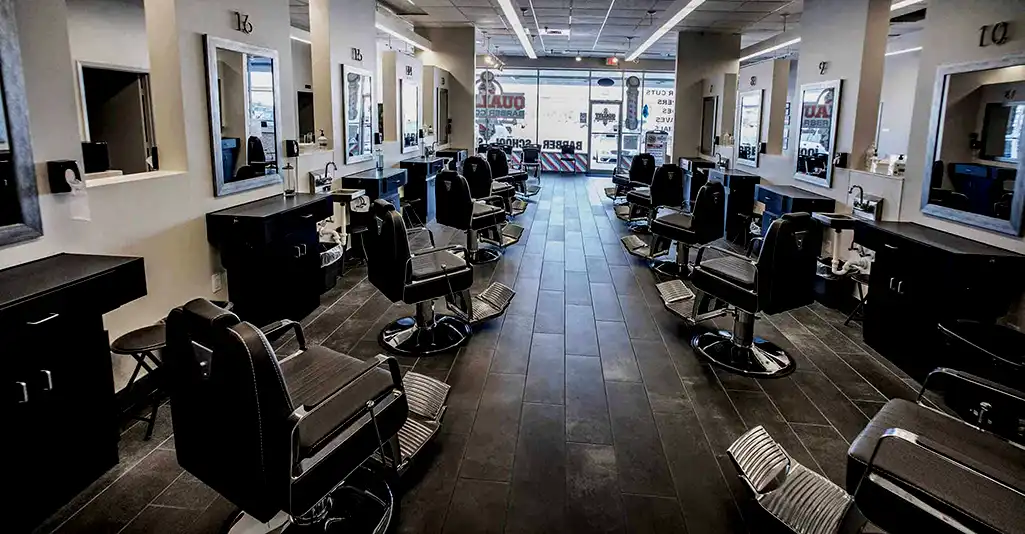
- Can I see the student salon floor in action?
Beyond the Books: Mastering Clinical Training and Your First Professional Kit
Theory is essential, but you simply cannot learn a skin fade from a textbook. That is why hands-on clinical training in Texas barbering schools is the heart of your education. Once you complete your initial classroom phase, you move to the student salon floor to work on real clients under strict instructor supervision. This stage is about more than just technique; it is where you master the Texas Department of Licensing and Regulation (TDLR) sanitation protocols. You will spend a significant portion of your time learning to clean, disinfect, and sterilize your station to ensure client safety, a non-negotiable habit for passing your state board exams.
Your ability to perform these cuts relies entirely on the quality of your equipment. Most tuition packages include a professional barbering kit essentials for students, which acts as your starter toolbox for the trade. While specific brands vary by school, every standard kit generally contains:
- Adjustable blade clippers and detail trimmers
- Professional-grade shears and texturizing scissors
- A variety of combs, brushes, and sectioning clips
- TDLR-compliant sanitation sprays and coolants
With your tools in hand and your station prepped, the next challenge is fitting these required hours into your life.
Full-Time vs. Evening Classes: Designing a Schedule That Fits Your Houston Hustle
Committing to a new trade doesn’t mean you have to quit your current job immediately. Most local institutions offer flexible tracks to help you hit that 1,000-hour target without sacrificing your income. While the debate regarding barbering apprenticeship vs traditional schooling in Texas often comes up, traditional schools remain the preferred route; apprenticeships are difficult to secure and typically take much longer to complete than a structured program. Comparing full-time vs part-time barbering courses essentially comes down to a trade-off between speed and immediate financial stability.
To help you visualize the commitment, here is how the different tracks generally break down:
- Full-Time (30–40 hours/week): Rapid immersion allowing graduation in approximately 6 to 8 months.
- Part-Time (15–20 hours/week): A steady pace requiring about 12 to 14 months to complete.
Evening barbering classes for working students in Houston typically run from 5:00 PM to 10:00 PM, allowing you to keep your day job while building your future. Once you clock that final hour, you face the ultimate validation of your training.
From Classroom to Chair: Nailing the Texas State Board and Finding Your First Job
Finishing your clock hours is a huge milestone, but the final hurdle is the Texas Department of Licensing and Regulation (TDLR) assessment. You will head to a PSI testing center for two specific challenges: a written theory test covering laws and anatomy, and a practical exam where you demonstrate sanitation and cutting skills on a mannequin.
Here are three Texas barber state board exam preparation tips to ensure you pass on the first try:
- Master Sanitation Rules: Safety counts more than style; if you drop a comb during the practical, know the exact disinfection procedure immediately.
- Check Your Kit: Verify your supplies against the PSI candidate bulletin the night before, as missing tools can lead to automatic failure.
- Time Your Cuts: Practice your required procedural cuts with a stopwatch to ensure you can finish within the strict time limits.
Don’t wait until your license arrives to start networking. Many programs offer barbering career placement services in Houston, connecting you with shops in busy hubs like the Heights or Katy before graduation. Use these resources to find a mentor who values your training and can help smooth your transition from student to professional.
Financial independence is the goal, but your income structure will likely evolve as you build a client base. Most rookies start on commission—splitting income with the shop owner—before eventually switching to ‘chair rental,’ where you pay a flat weekly fee to keep 100% of your earnings. While an entry-level licensed barber salary in Houston depends heavily on your hustle, skilled barbers in high-traffic areas can quickly scale their income well beyond initial expectations.
Your Houston Barbering Blueprint: 3 Steps to Start Your Enrollment Today
Making the transition from interested observer to enrolled student shifts your trajectory from a simple job seeker to a skilled tradesperson. The diverse, booming population across the city ensures that the benefits of local barber college enrollment extend far beyond the classroom. You are entering a recession-resistant industry where your hands create your paycheck, securing a creative and stable future right here in the heart of Texas.
Momentum is key to success in this trade. Turn your research into reality with this simple 24-hour plan to launch your future at a Barber School In Houston:
- Shortlist Three Schools: Select your top contenders based on commute time and shop culture.
- Schedule Tours: Call admissions immediately to see the student floor in action.
- Check Funding: Start your FAFSA application or ask schools about specific payment plans.
Quality Barber College
713-900-4722
12363 S Main Street
Houston, TX 77035
View Google Business Listing